phone iconSpeak with our expert +17373177806

Delivered in collaboration with Great Learning

Learn more about the course

Get details on syllabus, projects, tools, and more

Name
Email
Mobile Number

By submitting this form, you consent to our Terms of Use & Privacy Policy and consent to be contacted via email, phone (including by AI-generated/pre-recorded voice calls), SMS, or WhatsApp.

Upskill Your Teams with Future-Ready Skills

Empower your workforce with programs from leading universities

  • Team Pricing

    Maximize ROI with exclusive cost-effective plans for group enrollments

  • Team Learning Dashboard

    Track progress & outcomes at the team level

  • Customized Learning Paths

    Tailor the program to align with your team's goals and drive meaningful outcomes.

Enter your organisation name

This will help us customise the proposal plans

Company Name
Post Graduate Program in AI Agents for Business Applications

Post Graduate Program in AI Agents for Business Applications

Application closes 13th Nov 2026

Why Should You Join This Program?

  • List icon

    Build AI Agents Without Coding

    Progress from Generative AI foundations to single-agent design and coordinated multi-agent workflows, with evaluation, guardrails, and human oversight built into the curriculum.

  • List icon

    Texas McCombs Is a Top-Ranked U.S. University

    Learn from a top U.S. business school, ranked #1 in Information Systems, #6 for Master’s in Business Analytics, #7 in Artificial Intelligence, and #9 in Business Analytics in the U.S.

LEARNING OUTCOMES

What Will You Learn to Build and Apply?

Through a structured learning journey, you will build the capability to:

  • Navigate the AI landscape and understand foundational concepts to address common business challenges

  • Apply and evaluate LLM and prompt engineering techniques to generate reliable outputs and optimize performance

  • Implement and evaluate RAG systems by leveraging embeddings, vector databases, and external knowledge sources

  • Develop context-aware single-agent systems to automate workflows and improve operational efficiency

  • Design and evaluate scalable, transparent multi-agent solutions to ensure reliable enterprise AI solutions

Earn a certificate of completion and CEUs from Texas McCombs, a top-ranked U.S. university

  • #1 (U.S., Big Data Management) in MS Business Analytics

    #1 (U.S., Big Data Management) in MS Business Analytics

    Eduniversal (2025)

  • #6 Analytics

    #6 Analytics

    U.S. News & World Report (2025)

  • #6 Business Programs

    #6 Business Programs

    U.S. News & World Report (2025)

  • #7 in MS - Business Analytics

    #7 in MS - Business Analytics

    QS World University Rankings (2022)

  • #7 in MS Business Analytics

    #7 in MS Business Analytics

    The Financial Engineer Times (2025)

  • #3 in Information Systems Graduate Programs

    #3 in Information Systems Graduate Programs

    U.S. News & World Report (April 2025)

  • #7 Public University in the U.S.

    #7 Public University in the U.S.

    U.S. News & World Report, 2026

  • #6 in Executive Education - Custom Programs

    #6 in Executive Education - Custom Programs

    Financial Times, 2022

KEY PROGRAM HIGHLIGHTS

Why Choose This Program?

  • List icon

    Learn from Texas McCombs Faculty

    Build core foundations through recorded lectures and monthly faculty-led masterclasses that connect AI concepts to business applications

  • List icon

    Design, Build, and Evaluate AI Agents Without Writing Code

    This program offers a structured No-Code Track, progressing from Generative AI foundations to single-agent design and coordinated multi-agent workflows

  • List icon

    Optional Add-On Advanced Learning Program

    Deepen your Agentic AI expertise with the Post Graduate Program in Advanced Agentic AI for Business Applications, available as an optional add-on upon completion of the program

  • List icon

    Build Hands-on Expertise to Solve Business Problems

    Apply concepts through hands-on projects and real-world case studies using industry tools, with n8n and OpenAI LLM access through Great Learning Labs.

  • List icon

    Attend Weekly Live Mentorship Sessions with Industry Experts

    Discuss case studies, see practical demos, clarify doubts, and understand how AI is applied in real-world workflows

  • List icon

    Specialized Module on Claude-Based AI Workflows

    Build expertise beyond the core curriculum with additional self-paced modules on Anthropic, developed by industry experts.

  • List icon

    Get Personalized Learning Support

    Receive guidance from a dedicated program support team, academic support, discussion forums, peer groups, and the Great Learning community

  • List icon

    Earn a Recognized Credential from Texas McCombs

    Earn a Certificate of Completion and Continuing Education Units (CEU’s) from the McCombs School of Business at The University of Texas at Austin, upon completion of the program

Skills you will learn

LARGE LANGUAGE MODELS

RETRIEVAL-AUGMENTED GENERATION

PROMPT ENGINEERING

PROMPT OPTIMIZATION

PROMPT STABILITY

SINGLE-AGENT SYSTEMS

MULTI-AGENT SYSTEMS

AGENTIC RAG

RESPONSIBLE AI

WORKFLOW EVALUATION

LARGE LANGUAGE MODELS

RETRIEVAL-AUGMENTED GENERATION

PROMPT ENGINEERING

PROMPT OPTIMIZATION

PROMPT STABILITY

SINGLE-AGENT SYSTEMS

MULTI-AGENT SYSTEMS

AGENTIC RAG

RESPONSIBLE AI

WORKFLOW EVALUATION

view more

  • Overview
  • Learning Journey
  • Curriculum
  • Projects
  • Tools
  • Certificate
  • Faculty
  • Mentors
  • Reviews
  • Career Support
  • Fees

Who Is the Program For?

For professionals, leaders, and consultants who want to apply AI agents without writing code

  • Professionals across business functions

    Design and build AI agents that automate and optimize workflows in sales, marketing, operations, finance, HR, or product, without writing code.

  • Strategic and functional leaders

    Understand what Agentic AI can and cannot do, evaluate where it fits, and guide adoption across your teams with the right safeguards.

  • Consultants

    Identify use cases, design and evaluate AI-powered workflows, and explore practical applications of Agentic AI across functions, without writing code.

How's the Learning Experience of the Program?

Build strategic judgement and human intuition with our unique structured learning approach

  • banner-image

    Learn from Experts

    Learn from Texas McCombs faculty and industry experts to master AI strategy and implementation

  • banner-image

    Learn By Doing

    Apply Agentic AI concepts through hands-on projects and real-world case studies

  • banner-image

    Earn a University Credential

    Earn a certificate of completion and Continuing Education Units (CEUs) from Texas McCombs

  • banner-image

    Get Support Throughout the Learning Journey

    A program management team will help you stay on track, and navigate key milestones

On-Campus Immersion (Optional Paid Program)

banner

Decision Science and AI: AI Workflows and Agents

In the 3-day immersive on-campus program, you will:

  • Connect with a cohort of like-minded AI-professionals
  • Engage with world-class faculty at the AT&T Hotel & Conference Center
  • Learn first-hand from global industry experts
  • Earn 1 Continuing Education Unit (CEU) upon program completion

Reach out to your Program Advisor for more details

What Will You Learn in the Program?

The curriculum, offered by the McCombs School of Business at The University of Texas at Austin, covers everything from Generative AI and large language model fundamentals to prompt optimization, RAG, single-agent design, responsible AI, and multi-agent workflow evaluation.

PRE-WORK

This module introduces learners to the AI landscape. They explore key concepts, technologies, and business applications of AI, Generative AI, and Agentic AI. The module also provides foundational knowledge of the tools and environments used throughout the program. Learners begin building AI-powered solutions using no-code tools.

Concepts Covered

- Introduction to the World of Data and AI - No-Code Tool Setup

MODULE 01 | GENERATIVE AND AGENTIC AI FOUNDATIONS

In this module, learners gain an overview of the Generative AI and Agentic AI landscape. They explore the critical distinctions between generative and discriminative AI and their applications. They also gain an understanding of bias and hallucination associated with modern AI systems. Learners then build a strong foundation in how large language models (LLMs) work and in prompt engineering techniques. They explore techniques to improve prompt stability, automate prompt optimization, and establish robust evaluation of Generative AI workflows through deterministic metrics and LLM-as-a-Judge. Finally, learners explore Retrieval-Augmented Generation (RAG), including how to chunk documents, query vector databases, and systematically evaluate retrieval quality to ground models in authoritative external knowledge.

Week 1 | The Generative AI and Agentic AI Landscape

- Differentiate between generative and discriminative AI approaches and explain the working principles of Large Language Models (LLMs) - Evaluate key risks associated with Generative AI, such as bias and hallucination, and identify considerations for responsible use - Assess business applications of Generative AI across areas such as content creation, customer support, and knowledge management - Demonstrate effective interaction with Generative AI and Agentic AI systems (e.g., ChatGPT) to perform tasks such as research and information synthesis

Week 2 | Large Language Models and Prompt Engineering

- Explain the fundamentals of Large Language Models (LLMs) and their underlying mechanisms - Analyze real-world business applications of LLMs to enhance decision-making - Apply prompt engineering strategies to optimize LLM outputs for improved task performance and efficiency

Week 3 | Prompt Optimization and Evaluation

- Evaluate prompt stability by measuring consistency across multiple non-deterministic LLM runs and implementing prompt versioning strategies - Measure the quality of LLM outputs using evaluation metrics such as accuracy, hallucination rates, and confidence scores (e.g., log probabilities) - Apply prompt optimization techniques to improve model performance beyond manual prompting - Design and implement scalable evaluation frameworks by leveraging LLM-as-a-Judge methods and curated gold-standard datasets for reliable human evaluation

Week 4 | Retrieval-Augmented Generation

- Explain the need for external knowledge sources to enhance the accuracy and reliability of Large Language Model outputs - Apply techniques such as data chunking and embeddings to prepare unstructured data for effective retrieval in AI systems - Describe the role of vector databases in enabling semantic search and efficient retrieval of relevant information - Implement and evaluate Retrieval-Augmented Generation (RAG) pipelines to improve factual grounding and performance of AI-powered applications

Week 5 | Learning Break

Week 6 | Project Week

MODULE 02 | BUSINESS APPLICATIONS WITH AGENTIC AI

In this module, learners build on a fundamental understanding of LLMs to explore the design and implementation of AI Agents for automating business workflows. They begin by learning about the foundational components of Agentic AI architectures, including the ReAct (Reasoning and Acting) framework and multi-step reasoning for task decomposition. They also explore practical tool integration patterns and memory incorporation in AI Agents. Learners then examine the fundamental differences between LLMs and classical software security. They ground solutions in the CIA Triad (Confidentiality, Integrity, and Availability) and analyze critical failure modes such as prompt injection attacks. Finally, they learn to implement layered guardrails to architect resilient AI Agents governed by responsible AI principles and safety boundaries.

Week 7 | Single-Agent Systems

- Explain the concept of AI agents and describe their core components, including perception, reasoning, action, and interaction with external environments - Analyze different agentic AI architectures and identify suitable design patterns for building autonomous AI systems - Apply frameworks such as ReAct and relevant agentic AI tools to enable reasoning, tool usage, and task execution in agent workflows - Explain and implement mechanisms for agent memory for context management, including the role of protocols such as Model Context Protocol (MCP) in enabling tool and knowledge integration

Week 8 | Responsible AI

- Explain the CIA Triad (Confidentiality, Integrity, Availability) and apply it as a framework to assess security risks in LLM-based systems - Identify and analyze common security vulnerabilities in LLM applications, including prompt injection and other adversarial attack vectors - Implement mitigation strategies and guardrail layers to protect LLM systems from misuse, data leakage, and malicious inputs - Design and evaluate secure Generative AI solution architectures while incorporating responsible AI practices and governance checklists

Week 9 | Project Week

MODULE 03 | ADVANCED AGENTIC AI SOLUTIONS

In this module, learners explore how to orchestrate a team of AI Agents for complex business applications. They begin by analyzing the operational bottlenecks of single-agent workflows. They then explore multi-agent orchestration as a scalable coordination solution and Agentic RAG pipelines, where multiple agents collaborate across complex data retrieval and response generation stages. Learners also evaluate AI Agents using metrics such as task completion rate, tool call accuracy, reasoning coherence, and latency. They explore human-in-the-loop validation to ensure accuracy and reliability in Agentic AI solutions.

Week 10 | Multi-Agent Systems

- Analyze the limitations and challenges of single-agent LLM systems in handling complex, multi-step, and collaborative tasks - Explain how multi-agent systems address these challenges by enabling coordination, specialization, and distributed problem-solving - Compare and evaluate common multi-agent architectures and frameworks used to design collaborative agent ecosystems - Design agentic workflows that incorporate techniques such as Agentic RAG to enhance reasoning, knowledge retrieval, and task execution in multi-agent environments

Week 11 | Evaluating Agentic AI Systems

- Evaluate the effectiveness of AI agents using Task Completion Rate to determine how successfully agents achieve their assigned objectives - Assess the correctness of agent interactions with external systems by measuring Tool Call Accuracy - Analyze the quality and logical consistency of agent reasoning using Reasoning Trajectory Coherence, including automated approaches such as LLM-as-a-Judge - Measure agent performance efficiency using metrics such as latency and convergence score to assess speed and resource utilization - Implement Human-in-the-Loop evaluation processes to review and validate agent outputs

Week 12 | Project Week

SELF-PACED COURSES

Claude-based AI Workflows

This module builds learners’ practical capability in applying Generative AI and Agentic AI using the Claude ecosystem. They build the ability to design, execute, and evaluate AI-driven workflows for real-world applications using Claude Chat and Claude CoWork, following a Plan, Approve, Execute, Iterate framework. - Model selection and prompt engineering using Claude Chat - Agentic workflow design and orchestration using Claude CoWork - Plan, Approve, Execute, Iterate framework - Designing workflows with reasoning, tools, and multi-step execution - Applying concepts through real-world case studies *Disclaimer: Claude API access is not included as part of the program. Learners may explore advanced usage independently.

MASTERCLASSES

Multimodal Generative AI Masterclass

This masterclass explores how to solve business problems using Generative AI. Learners examine the capabilities of text-to-image and image-to-text tools. They also explore the speech recognition capabilities of audio-to-text Generative AI tools through business use cases. - Image Generation using GenAI - Audio Generation using GenAI

Anthropic Series Masterclass

This masterclass explores how to design, build, and deploy agentic workflows using Anthropic’s frontier capabilities. Learners begin with prompt engineering for Claude, leveraging system prompts, chain-of-thought, connectors, and thinking modes for deep reasoning. They then explore Claude Cowork for automating complex knowledge work through agentic loops, task oversight, and specialized skills. - Prompt engineering for Claude, system prompts, chain-of-thought, connectors, and thinking modes - Claude Cowork for automating complex knowledge work through agentic loops - Task oversight and specialized skills

Note: The curriculum listed above are indicative and subject to updates as technology evolves.

What Case Studies & Projects Will You Solve?

Work on real-world case studies across industries & functions using 15+ tools and technologies

project icon

Sample Project | Finance

Driving Investment Performance Through Grounded Synthesis

Description

Build a RAG-powered market intelligence assistant that enables brokers to query financial news and regulatory filings in natural language and deliver accurate, source-backed insights that improve investment recommendations.

Skills you will learn

  • Large Language Models
  • Prompt Stability
  • Retrieval-Augmented Generation
  • Embeddings
  • Vector Databases
  • OpenAI
  • LLM Evaluation
  • Financial Document Analysis
project icon

Sample Project | Healthcare

AI-Powered EHR Assistant

Description

Improve patient understanding and reduce support burden by implementing a guardrailed AI assistant that explains EHR information in plain language, answers general medical questions using trusted sources, and enforces strict safety and privacy constraints within the patient portal.

Skills you will learn

  • Single-Agent System
  • Tool Calling
  • ReAct
  • Large Language Models
  • OpenAI
  • LLM Evaluation
  • Responsible AI
project icon

Sample project | logistics and supply chain

AI-Powered Last-Mile Delivery Exception Handling Automation

Description

Improve last-mile logistics efficiency by implementing a multi-agent AI system that detects delivery exceptions from operational logs, applies policy-based reasoning to determine optimal resolution actions, generates personalized customer communications, and escalates complex cases while maintaining full auditability.

Skills you will learn

  • Multi-Agent System
  • Agentic RAG
  • OpenAI
  • Agent Evaluation
  • Human-in-the-Loop Evaluation
  • Workflow Automation
  • Responsible AI
project icon

SAMPLE CASE STUDY | Retail

Retail Order Query Chatbot

Description

Enable dynamic, context-aware interactions that assist customers with product queries and order tracking by developing a retail chatbot using a multi-agent system, improving the overall shopping experience.

Skills you will learn

  • Agentic AI
  • Multi-Agent Systems
  • Chatbot Development
  • Context-Aware Interaction
project icon

Sample Case Study | e-commerce

AI-Powered Customer Feedback Analyzer

Description

Build an AI-powered customer feedback analysis system that delivers grounded, technically detailed review summaries with automated quality evaluation and continuous prompt optimization, enabling Product Managers to identify actionable product improvements, reduce decision-making errors, and enhance customer satisfaction.

Skills you will learn

  • Large Language Models
  • Prompt Optimization
  • Prompt Stability
  • Generative AI Evaluation
  • LLM-as-a-Judge
  • OpenAI
project icon

Sample Case Study | Insurance

Insurance Policy Q&A

Description

Build an AI-powered insurance policy Q&A assistant that delivers accurate, source-grounded answers with exact policy citations across plans and policy years, using continuous evaluation to ensure reliability, safe responses, and auditable compliance while reducing support delays and misrepresentation risks.

Skills you will learn

  • Large Language Models
  • Retrieval Augmented Generation
  • Embeddings
  • Vector Databases
  • Generative AI Evaluation
  • LLM-as-a-Judge
  • OpenAI
project icon

Sample Case Study | Finance

ClaimAudit AI

Description

Build an AI-powered healthcare claims audit assistant that converts natural-language questions into safe, validated SQL queries and delivers accurate, explainable, audit-ready insights in real time, accelerating investigations, strengthening compliance oversight, and reducing reliance on data and IT teams.

Skills you will learn

  • Large Language Models
  • Responsible AI
  • Prompt Injection Mitigation
  • Guardrails
  • Generative AI Evaluation
  • LLM-as-a-Judge
  • OpenAI
project icon

SAMPLE CASE STUDY | Human Resources

Policy Driven HR Assistant

Description

Build an AI-powered HR support agent that retrieves employee-specific data, interprets HR policies, and performs necessary calculations to resolve routine employee queries accurately and reliably, with human escalation for uncertain cases to ensure trustworthy, policy-compliant responses.

Skills you will learn

  • Single-agent System
  • ReAct
  • OpenAI
  • Policy Validation
  • LLM-as-a-Judge
project icon

Sample Case Study | Customer Support

AI Helpdesk Co-Pilot

Description

Improve customer support efficiency by implementing an agentic AI system that classifies support tickets, retrieves relevant knowledge, and generates grounded, policy-compliant first responses with explainable reasoning and automated escalation when needed.

Skills you will learn

  • Multi-agent System
  • Agentic RAG
  • OpenAI
  • Customer Support Efficiency
project icon

SAMPLE CASE STUDY | lOGISTICS

AI-Powered Shipment Disruption Router

Description

Improve logistics operational efficiency by implementing a multi-agent AI system that analyzes shipment disruptions, retrieves policy-based mitigation rules, and generates validated routing decisions with escalation for high-risk cases while maintaining full auditability.

Skills you will learn

  • Improve logistics operational efficiency by implementing a multi-agent AI system that analyzes shipment disruptions
  • retrieves policy-based mitigation rules
  • and generates validated routing decisions with escalation for high-risk cases while maintaining full auditability.
project icon

SAMPLE CASE STUDY | Manufacturing

Feasibility Report Generator

Description

Build an AI-powered manufacturing feasibility assessment system that compares client LVAD requirements against existing manufacturing capabilities and documentation to generate and evaluate structured feasibility reports, identifying capability gaps, required modifications, cost implications, and overall production viability.

Skills you will learn

  • Large Language Models
  • Prompt Engineering
  • LLM-as-a-Judge
  • OpenAI

Note: The projects and case studies listed above are indicative and subject to updates to the curriculum.

Which Tools Will You Learn and Apply?

Learn to leverage cutting-edge no-code tools to build and optimize AI models and workflows

  • tools-icon

    n8n

  • tools-icon

    ChatGPT

  • tools-icon

    Gemini

  • tools-icon

    Google AI Studio

  • tools-icon

    Gemini Notebook

  • tools-icon

    Claude

Note: The tools listed above are indicative and subject to updates as technology evolves.

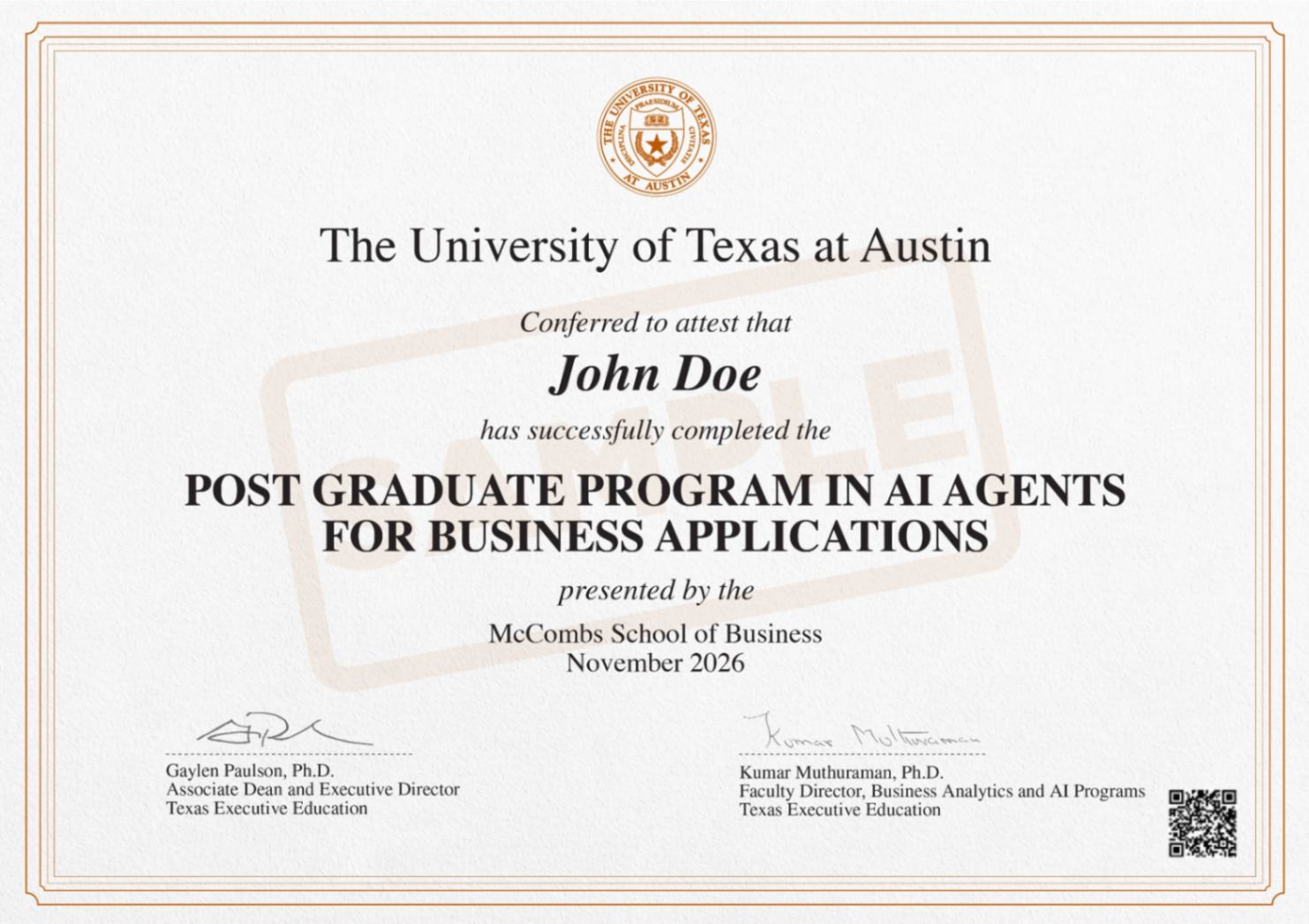
Earn a Certificate of Completion From Texas McCombs

Stand out in a competitive market with a Certificate of Completion in Post Graduate Program in AI Agents for Business Applications that validates the expertise developed through rigorous, practical assessments.

certificate image

* Image for illustration only. Certificate subject to change.

Who Are the Faculty for the Program?

Learn from renowned Texas McCombs faculty and build technical intuition to make credible, strategic decisions

  • Dr. Kumar Muthuraman

    Dr. Kumar Muthuraman

    Faculty Director, McCombs School of Business, The University of Texas at Austin

    Faculty Director, Center for Analytics and Transformative Technologies

    21+ years' experience in AI, ML, Deep Learning, and NLP.

    Know More
    Company Logo
  • Dr. Daniel A Mitchell

    Dr. Daniel A Mitchell

    Clinical Assistant Professor, McCombs School of Business, The University of Texas at Austin

    Ph.D. in Information, Risk, and Operations Management

    15+ years of experience in financial engineering

    Know More
    Company Logo
  • Dr. Abhinanda  Sarkar

    Dr. Abhinanda Sarkar

    Senior Faculty & Director Academics, Great Learning

    30+ years of experience in data science, ML, and analytics.

    Ph.D. from Stanford, taught at MIT, ISI, and IIM Bangalore.

    Know More
    Company Logo
  • Dr. Davood Wadi

    Dr. Davood Wadi

    Supporting Program Faculty

    Assistant Professor, University Canada West (PhD. in Marketing/AI)

    Former Artificial Intelligence Researcher at HEC Montréal

    Know More

Who Are the Mentors for Weekly Live Sessions?

Learn from seasoned AI industry mentors in weekly live sessions to apply concepts and build practical skills

  •  Bhaskarjit Sarmah  - Mentor

    Bhaskarjit Sarmah linkin icon

    Head of AI Research, Domyn
    Company Logo
  •  Juan Jose Ortiz  - Mentor

    Juan Jose Ortiz linkin icon

    Managing Director, Data Analytics & AI at Hartman Executive Advisors
    Company Logo
  •  Giancarlo Crocetti  - Mentor

    Giancarlo Crocetti linkin icon

    Director of the St. John’s AI Institute
    Company Logo
  •  Vinicio Desola Jr  - Mentor

    Vinicio Desola Jr linkin icon

    Staff Data Scientist, Newmark
    Company Logo

Note: The mentors listed above are indicative and subject to change based on availability and scheduling.

What Support Will You Receive to Advance in Your Career?

  • banner-image

    Mentorship from Experts

    Learn from industry practitioners who help you apply concepts and develop practical, real-world skills.

  • banner-image

    Interview Preparation

    Get an insiders perspective to understand what recruiters are looking for

  • banner-image

    Resume and Profile Review

    Get your resume and LinkedIn profile reviewed by our experts to highlight your Agentic AI skills & projects

  • banner-image

    E-Portfolio of Hands-On Projects

    Build an industry-ready portfolio to showcase your mastery of skills and tools

Course Fees

The course fee is
USD 3,450 USD 3,100

Invest in your career

  • benifits-icon

    Build hands-on proficiency in large language models, RAG, single-agent systems, and multi-agent systems

  • benifits-icon

    Apply your learning through hands-on projects and real-world case studies using visual, no-code tools

  • benifits-icon

    Learn from global industry experts in live online mentorship sessions during the program

  • benifits-icon

    Receive a Certificate of Completion and CEUs from Texas McCombs

Take the next step

timer
00 : 00 : 00

Apply to the program now or schedule a call with a program advisor

Unlock exclusive course sneak peek

Application closes: 13th Nov 2026

Application closes: 13th Nov 2026

Talk to our advisor for offers & course details

Application Process

Applications close once the required number of participants enroll. Apply early to secure your spot

  • steps icon

    Fill the application form

    Register by completing the online application form.

  • steps icon

    Application screening

    A panel from Great Learning will review your application to determine your fit for the program.

  • steps icon

    Join the program

    Receive an offer for a seat in the upcoming cohort of the program after a final review.

Batch Start Date

  • Online · 14th Nov 2026

    Admission closing soon

Delivered in Collaboration with:

The McCombs School of Business at the University of Texas at Austin is collaborating with online education provider Great Learning to offer the Post Graduate Program in AI Agents for Business Applications. Great Learning collaborates with institutions to manage enrollments (including all payment services and invoicing), technology, and participant support.

Got more questions? Talk to us

Connect with our advisors and get your queries resolved

Speak with our expert +17373177806 or email to agaiba.utaustin@mygreatlearning.com

career guidance