AI Agents Course for Tech Professionals to Build and Deploy Multi-Agent Systems
Post Graduate Program in AI Agents for Business Applications
 Application closes on
7th Nov 2026

 Speak with our expert
+15127980680




Learn more about the course
Get details on syllabus, projects, tools, and more
Upskill Your Teams with Future-Ready Skills
Empower your workforce with programs from leading universities
-
Team Pricing
Maximize ROI with exclusive cost-effective plans for group enrollments
-
Team Learning Dashboard
Track progress & outcomes at the team level
-
Customized Learning Paths
Tailor the program to align with your team's goals and drive meaningful outcomes.

Enter your organisation name
This will help us customise the proposal plans

Post Graduate Program in AI Agents for Business Applications
Application closes 7th Nov 2026
Why Should You Join This Program?
-

Build Agentic AI Systems with Python
Progress from Python and LLM foundations to RAG pipelines, single-agent systems, and coordinated multi-agent architectures through hands-on projects.
-
Texas McCombs is a top-ranked US University
Learn from a top U.S. business school, ranked #1 in Information Systems, #6 for Master’s in Business Analytics, #7 in Artificial Intelligence, and #9 in Business Analytics in the U.S.


LEARNING OUTCOMES
What Will You Learn to Build and Apply?
Through a structured learning journey, you will build the capability to:
-
Navigate the AI landscape and apply foundational concepts to business challenges across industries
-
Use LLMs and prompt engineering to generate reliable outputs, boost performance, and improve prompt stability
-
Implement and evaluate RAG systems using embeddings, vector databases, and external knowledge sources
-
Develop context-aware single-agent systems by integrating tools and memory to automate workflows
-
Apply planning and reasoning strategies that enable agents to decompose tasks and adapt to dynamic scenarios
-
Design and evaluate scalable, transparent multi-agent ecosystems for reliable enterprise AI solutions
Earn a certificate of completion and CEUs from Texas McCombs, a top-ranked U.S. university
-
#1 (U.S., Big Data Management) in MS Business Analytics
Eduniversal (2025)
-
#6 Analytics
U.S. News & World Report (2025)
-
#6 Business Programs
U.S. News & World Report (2025)
-
#7 in MS - Business Analytics
QS World University Rankings (2022)
-
#7 in MS Business Analytics
The Financial Engineer Times (2025)
-
#3 in Information Systems Graduate Programs
U.S. News & World Report (April 2025)
-
#7 Public University in the U.S.
U.S. News & World Report, 2026
-
#6 in Executive Education - Custom Programs
Financial Times, 2022


Key program highlights
Why Choose This Program?
-
Learn from Texas McCombs Faculty
Build core foundations through recorded lectures and monthly faculty-led masterclasses that connect AI concepts to business applications
-
Prefer a No-Code Pathway?
Connect with a program advisor to learn more about the No-Code Track, implemented through visual, no-code platforms and requiring no prior programming experience.
-
Build Hands-on Expertise to Solve Business Problems
Create an industry-ready portfolio of hands-on agentic AI projects and case studies that showcase real-world AI mastery
-
Get Personalized Learning Support
Receive guidance from a dedicated program manager, academic support, discussion forums, peer groups, and the Great Learning community
-
Attend Weekly Live Mentorship Sessions with Industry Experts
Discuss case studies, see practical demos, clarify doubts, and understand how AI is applied in real-world workflows
-
Earn a Recognized Credential from Texas McCombs
Earn a Certificate of Completion from the McCombs School of Business at The University of Texas at Austin, upon completion of the program


Skills you will learn
Python
Generative AI
Agentic AI
Large Language Models
Prompt Engineering
Prompt Optimization
Retrieval-Augmented Generation
Embeddings
Vector Databases
LangChain
LangGraph
ReAct
Model Context Protocol
Multi-Agent Systems
Responsible AI
LLM Evaluation
Human-in-the-Loop Evaluation
Python
Generative AI
Agentic AI
Large Language Models
Prompt Engineering
Prompt Optimization
Retrieval-Augmented Generation
Embeddings
Vector Databases
LangChain
LangGraph
ReAct
Model Context Protocol
Multi-Agent Systems
Responsible AI
LLM Evaluation
Human-in-the-Loop Evaluation
view more
- Overview
- Learning Journey
- Curriculum
- Projects
- Tools
- Certificate
- Faculty
- Mentors
- Reviews
- Fees
Who Is the Program For?
Build the technical depth to design, evaluate, and guide Agentic AI solutions for business applications.
-
Business and Technology Professionals
Translate business process workflows into agentic workflows and lead their adoption.
-
Data, AI, and Technology Practitioners
Build intelligent agentic systems that can reason, make decisions, and adapt to dynamic environments.
-
Technology Leaders
Develop the technical depth to evaluate, govern, and guide the agentic systems their teams build.
How's the Learning Experience of the Program?
Build strategic judgement and human intuition with our unique structured learning approach
-
Learn from Experts
Learn from Texas McCombs faculty and industry experts to master AI strategy and implementation
-
Learn By Doing
Work on business problems & case studies using 15+ tools & build an e-portfolio of AI projects
-
Earn a University Credential
Earn a certificate of completion from Texas McCombs
-
Get Support Throughout the Learning Journey
A program management team will help you stay on track, and navigate key program milestones




What Will You Learn in the Program?
Designed by Texas McCombs faculty, the curriculum progresses from Python and Generative AI foundations to RAG, single-agent systems, responsible AI, and multi-agent orchestration. Explore prompt optimization, tool integration, memory, system evaluation, and human-in-the-loop validation through structured modules and project work.
-
Hands-on
Projects
-
15+
Tools and techniques
-
Real-world
Case studies
PRE-WORK
This module introduces learners to the AI landscape. They explore key concepts, technologies, and business applications of AI, Generative AI, and Agentic AI. The module also provides foundational knowledge of the tools and environments used throughout the program. Learners begin building AI-powered solutions using no-code tools.
Concepts Covered
MODULE 01 | GENERATIVE AND AGENTIC AI FOUNDATIONS
In this module, learners gain an overview of the Generative AI and Agentic AI landscape. They explore the critical distinctions between generative and discriminative AI and their applications. They also gain an understanding of bias and hallucination associated with modern AI systems. Learners then build a strong foundation in how large language models (LLMs) work and in prompt engineering techniques. They explore techniques to improve prompt stability, automate prompt optimization, and establish robust evaluation of Generative AI workflows through deterministic metrics and LLM-as-a-Judge. Finally, learners explore Retrieval-Augmented Generation (RAG), including how to chunk documents, query vector databases, and systematically evaluate retrieval quality to ground models in authoritative external knowledge.
Week 1 | The Generative AI and Agentic AI Landscape
Week 2 | Python Programming with Generative AI
Week 3 | Large Language Models and Prompt Engineering
Week 4 | Prompt Optimization and Evaluation
Week 5 | Retrieval-Augmented Generation
Week 6 | Learning Break
Week 7 | Project Week
MODULE 02 | BUSINESS APPLICATIONS WITH AGENTIC AI
In this module, learners build on a fundamental understanding of LLMs to explore the design and implementation of AI Agents for automating business workflows. They begin by learning about the foundational components of Agentic AI architectures, including the ReAct (Reasoning and Acting) framework and multi-step reasoning for task decomposition. They also explore practical tool integration patterns and memory incorporation in AI Agents. Learners then examine the fundamental differences between LLMs and classical software security. They ground solutions in the CIA Triad (Confidentiality, Integrity, and Availability) and analyze critical failure modes such as prompt injection attacks. Finally, they learn to implement layered guardrails to architect resilient AI Agents governed by responsible AI principles and safety boundaries.
Week 8 | Single-Agent Systems
Week 9 | Advanced Tools and Planning in AI Agents
Week 10 | Responsible AI
Week 11 | Project Week
MODULE 03 | ADVANCED AGENTIC AI SOLUTIONS
In this module, learners explore how to orchestrate a team of AI Agents for complex business applications. They begin by analyzing the operational bottlenecks of single-agent workflows. They then explore multi-agent orchestration as a scalable coordination solution and Agentic RAG pipelines, where multiple agents collaborate across complex data retrieval and response generation stages. Learners also evaluate AI Agents using metrics such as task completion rate, tool call accuracy, reasoning coherence, and latency. They explore human-in-the-loop validation to ensure accuracy and reliability in Agentic AI solutions.
Week 12 | Multi-Agent Systems
Week 13 | Evaluating Agentic AI Systems
Week 14 | Project Week
SELF-PACED COURSES
Attention Mechanism and Transformers
Fine-tuning Language Models
Claude-based AI Workflows
MASTERCLASSES
Multimodal Generative AI Masterclass
Anthropic Series Masterclass
Note: The curriculum listed above are indicative and subject to updates as technology evolves.
What Case Studies & Projects Will You Solve?
Work on real-world case studies across industries & functions using 15+ tools and technologies

Sample Project | Finance
Driving Investment Performance Through Grounded Synthesis
Description
Build a RAG-powered market intelligence assistant that enables brokers to query financial news and regulatory filings in natural language and deliver accurate, source-backed insights that improve investment recommendations.
Skills you will learn
- Large Language Models
- Prompt Stability
- Retrieval-Augmented Generation
- Embeddings
- Vector Databases
- OpenAI
- LLM Evaluation
- Financial Document Analysis

Sample Project | Healthcare
AI-Powered EHR Assistant
Description
Improve patient understanding and reduce support burden by implementing a guardrailed AI assistant that explains EHR information in plain language, answers general medical questions using trusted sources, and enforces strict safety and privacy constraints within the patient portal.
Skills you will learn
- Single-Agent System
- Tool Calling
- ReAct
- Large Language Models
- OpenAI
- LLM Evaluation
- Responsible AI

Sample project | logistics and supply chain
AI-Powered Last-Mile Delivery Exception Handling Automation
Description
Improve last-mile logistics efficiency by implementing a multi-agent AI system that detects delivery exceptions from operational logs, applies policy-based reasoning to determine optimal resolution actions, generates personalized customer communications, and escalates complex cases while maintaining full auditability.
Skills you will learn
- Multi-Agent System
- Agentic RAG
- OpenAI
- Agent Evaluation
- Human-in-the-Loop Evaluation
- Workflow Automation
- Responsible AI

SAMPLE CASE STUDY | Retail
Retail Order Query Chatbot
Description
Enable dynamic, context-aware interactions that assist customers with product queries and order tracking by developing a retail chatbot using a multi-agent system, improving the overall shopping experience.
Skills you will learn
- Agentic AI
- Multi-Agent Systems
- Chatbot Development
- Context-Aware Interaction


Note: The projects and case studies listed above are indicative and subject to updates to the curriculum.
Which Tools Will You Learn and Apply?
Learn 15+ tools like OpenAI, Gemini, Hugging Face, Claude & more to build and optimize AI models and workflows
-
Python
-
Google Colab
-
VS Code (Visual Studio Code)
-
OpenAI
-
LangChain
-
ChromaDB
-
FAISS
-
LangChain ReAct














Note: The tools listed above are indicative and subject to updates as technology evolves.
Earn a Certificate of Completion From Texas McCombs
Stand out in a competitive market with a verified Post Graduate certificate in AI Agents for Business Applications that validates your AI expertise through rigorous, practical assessments
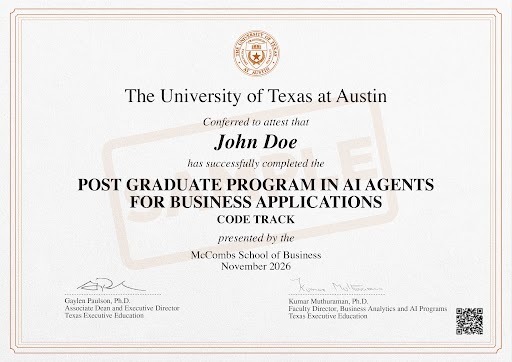
* Image for illustration only. Certificate subject to change.
Who Are the Faculty for the Program?
Learn from renowned Texas McCombs faculty and build technical intuition to make credible, strategic decisions
-
Dr. Kumar Muthuraman
Faculty Director, McCombs School of Business, The University of Texas at Austin
Faculty Director, Center for Analytics and Transformative Technologies
21+ years' experience in AI, ML, Deep Learning, and NLP.
Know More
-
Dr. Daniel A Mitchell
Clinical Assistant Professor, McCombs School of Business, The University of Texas at Austin
Ph.D. in Information, Risk, and Operations Management
15+ years of experience in financial engineering
Know More
-
Dr. Abhinanda Sarkar
Senior Faculty & Director Academics, Great Learning
30+ years of experience in data science, ML, and analytics.
Ph.D. from Stanford, taught at MIT, ISI, and IIM Bangalore.
Know More
-
Dr. Davood Wadi
Supporting Program Faculty
Assistant Professor, University Canada West (PhD. in Marketing/AI)
Former Artificial Intelligence Researcher at HEC Montréal
Know More







 LinkedIn Profile
 University Link
Who Are the Mentors for Weekly Live Sessions?
Learn from seasoned AI industry mentors in weekly live sessions to apply concepts and build practical skills
-
Bhaskarjit Sarmah
Head of AI Research, Domyn
-
Juan Jose Ortiz
Managing Director, Data Analytics & AI at Hartman Executive Advisors
-
Giancarlo Crocetti
Director of the St. John’s AI Institute
-
Vinicio Desola Jr
Staff Data Scientist, Newmark
.jpeg "Bhaskarjit Sarmah - Mentor")








Note: The mentors listed above are indicative and subject to change based on availability and scheduling.
What are the reviews for the program?
Learners share their feedback on the faculty, mentors, hands-on projects, and overall learning experience
-
I’ve completed the Agentic AI course from the University of Texas
Excited to share that I’ve completed the Agentic AI course from the University of Texas.
Read More
Arun Bhakuni
Senior Developer, CVS Health
Oct 2026
-
Turn a business problem into an agent workflow
I’m proud to share that I’ve completed the Post Graduate Program in AI Agents for Business Applications at the McCombs School of Business at The University of Texas at Austin. Throughout the program, I learned how to build AI agents using prompt engineering, retrieval-augmented generation, planning, and multi-agent systems. I also learned how to test, evaluate, and secure these systems so their answers remain grounded in reliable data. I applied these skills through three course projects: an HR policy assistant that answered employee questions using a company handbook, a LangGraph-based EHR patient assistant that explained lab results, medications, and visit notes with citations and safety guardrails, and a multi-agent workflow that identified and responded to last-mile delivery exceptions. These experiences taught me how to turn a business problem into an agent workflow, connect AI to trusted information, test difficult edge cases, and identify risks before deployment. I’m grateful to UT Austin and Texas McCombs for the opportunity to earn this postgraduate certificate before completing my undergraduate degree in May 2027. I look forward to applying what I learned across supply chain, finance, and artificial intelligence.
Read More
Adolfo Julian Campero
Oct 2026
-
The hands-on projects made it easy to understand the concepts
I had a great learning experience with Great Learning. The course was well organized, and the hands-on projects made it easy to understand the concepts. The instructors explained everything clearly and were very supportive. I would definitely recommend this program to anyone interested in learning AI.
Read More
Arif
Nike
Aug 2026
-
I've had a stellar experience with the postgraduate program
Provides a comprehensive and detailed curriculum, complete with highly available support from the instructors and program managers. I've had a stellar experience with the postgraduate program in agentic AI systems for business applications because I left the program with a solid understanding of the key learnings and principles. The instructors are highly skilled.
Read More
Daniel Anzaldo
Dynata
Aug 2026
-
From AI Foundations to Agentic AI: My Journey Through AI Leadership and AI Agents Programs
I recently completed two programs: Artificial Intelligence for Leaders and AI Agents for Business Applications. The Artificial Intelligence for Leaders program followed a structured, step-by-step progression, beginning with statistical foundations and advancing through machine learning, modern AI techniques, and Generative AI concepts. The AI Agents for Business Applications program complemented this learning journey by exploring large language models (LLMs) in greater depth and providing a systematic framework for designing, securing, and deploying business-focused agentic workflows. What stood out across both programs was the strong balance between theory and practical application. In addition to comprehensive lectures and video content, the program featured hands-on exercises and weekly mentored sessions. These elements not only reinforced key concepts but also helped translate theoretical knowledge into real-world business applications.
Read More
Anirban Mukherjee
Lead Software Engineer, Northwestern Mutual Life Insurance
May 2026
-
Building Real-World AI Skills Through Hands-On Learning and Expert Mentorship
I was contacted a couple of times by the Great Learning team about this AI program before deciding to attend, and I’m glad I did. The program was a great experience and truly exceeded my expectations. It helped me gain a much clearer understanding of how Artificial Intelligence (LLMs, Agents, and RAG) works, completely changing my perspective. I now feel well-prepared to apply AI solutions within any organization, especially with a strong understanding of the importance of putting the necessary guardrails in place to achieve reliable outcomes, knowing when to incorporate Human-in-the-Loop (HITL) for sensitive applications, and ensuring deterministic results. The program also introduced me to a wide range of tools that can be used to achieve desired outcomes effectively. The professors and mentors shared real-world experiences that were both thoughtful and highly insightful. I also appreciated the various projects throughout the program, which provided participants with high-level insights into Agentic AI solutions and their practical applications. Thank you for inspiring growth, knowledge, and excellence throughout the training. I truly enjoyed it. I would highly recommend this Postgraduate Program in AI Agents for Business Applications to anyone who wants to gain a comprehensive and practical understanding of AI, because you will learn a lot.
Read More
Eldert J. Louisa
Chief Technology Officer, CircleGX
May 2026
-
From Security Operations to Agentic AI: Expanding the CISO Toolkit for the AI Era
I am pleased to share that I have successfully completed the Postgraduate Program in AI Agents for Business Applications. As a cybersecurity leader, I recognize that the shift from static automation to Agentic AI represents a pivotal moment in enterprise architecture. This program provided a rigorous exploration of autonomous agents, moving beyond foundational large language models (LLMs) to the design and deployment of systems capable of independent reasoning, planning, and execution. For today's CISO, the value of this specialization is twofold: Defense at Machine Speed Leveraging agentic workflows to build an Autonomous Security Operations Center (SOC), where specialized AI agents proactively detect, correlate, investigate, and contain threats in real time. Securing the New Frontier Establishing the governance frameworks, identity controls, and guardrail architectures required to deploy AI agents securely within complex, global, and highly regulated enterprise environments. By integrating Agentic AI into cybersecurity strategy, organizations can evolve from a reactive security posture to a proactive business-enabling function—accelerating innovation while significantly reducing operational risk. A sincere thank you to the instructors, mentors, and my cohort for an enriching and thought-provoking experience. I look forward to applying these insights to drive resilient, secure, and strategic value in an increasingly AI-driven world.
Read More
Reid Wisa
Chief Information Security Officer, Real Performance Marketing
May 2026
-
Learning to Move Beyond Chatbots and Build Autonomous AI Agents
One of my key takeaways from the UT Austin's Program in AI Agents for Business Applications was understanding the transition from Generative AI to Agentic Workflows. The program provided deep insights into several critical areas shaping the future of enterprise AI. 1. The Evolution from Chatbots to Autonomous Agents The program effectively bridged the gap between traditional Generative AI applications and Agentic Workflows. While much of the industry remains focused on prompt-and-response interactions, the curriculum explored how AI systems can plan, reason, and execute multi-step tasks autonomously—functioning as a digital workforce rather than simply an information retrieval tool. 2. Orchestration Frameworks for Enterprise AI I gained hands-on experience with advanced orchestration approaches, including the ReAct (Reasoning and Acting) and Plan-and-Execute frameworks. Learning how to manage the ""brain"" of an AI agent—through memory management, tool integration, and LLM orchestration—provided valuable insights into building reliable, scalable, and self-correcting AI systems. 3. AI Governance, Safety, and Ethics As AI systems become increasingly autonomous, robust governance and ethical oversight become essential. The program emphasized the importance of human-in-the-loop architectures, AI governance frameworks, and safety guardrails designed to reduce hallucinations, manage risk, and ensure AI agents operate within organizational, regulatory, and ethical boundaries. 4. Academic Rigor with Practical Application What stood out most was the balance between academic depth and real-world relevance. The program established a strong foundation in the principles underlying Agentic AI while providing practical frameworks that can be applied to enterprise use cases today and adapted as the technology continues to evolve. As organizations move beyond experimentation and toward autonomous AI systems, understanding how to design, govern, and deploy AI agents responsibly will become an increasingly important leadership capability.
Read More
Somil Rastogi
SAS Institute Inc., Principal Solutions Architect
May 2026
-
An Eye-Opening Program That Enhanced My Data Analytics Skills
Enrolling in the Post Graduate Program in AI Agents for Business Applications broadened my understanding of relevant and up-to-date programming tools for data analysis. It also helped me acquire current skills in modeling and analytics for developing critical solutions across various fields.
Read More
Adewale Falade
Senior Consultant, Canopy Lab
Oct 2025








Course Fees
The course fee isUSD 3,450 USD 3,100
Invest in your career
-
14-Week Comprehensive Journey: Build practical skills in Python, Agentic AI, RAG, and multi-agent systems
-
Structured Learning: Learn through recorded faculty lectures and live monthly masterclasses.
-
Hands-On Learning: Apply concepts through hands-on projects and real-world case studies.
-
Earn a globally recognized Texas McCombs certificate and to validate your AI expertise


Admission Process
Admissions close once the required number of participants enroll. Apply early to secure your spot
-
Fill the application form
Register by completing the online application form.
-
Application screening
A panel from Great Learning will review your application to determine your fit for the program.
-
Join the program
Receive an offer for a seat in the upcoming cohort of the program after a final review


Batch Start Date
-
Online · To be announced
Admissions Open
 Application Closes
7th Nov 2026