
Built for Leaders to Drive Measurable Enterprise AI Strategy
Chief AI Officer (CAIO) Program
 Application closes on
30th Oct 2026
Application closes on
30th Oct 2026

 Speak with our expert
+17372719092
Speak with our expert
+17372719092




Learn more about the course
Get details on syllabus, projects, tools, and more

Chief AI Officer (CAIO) Program
Application closes 30th Oct 2026
Why Should You Participate in This Program?
-

Global Peer Network
Learn alongside a global cohort of senior professionals with similar mindsets through structured networking opportunities throughout the program, during the on-campus immersion, and beyond the program
-
On-Campus Immersion
Experience a 1-week immersion at Texas McCombs, gaining firsthand exposure to the University of Texas at Austin ecosystem and learning alongside faculty and peers


KEY OUTCOMES
How Will You Lead Enterprise-Level AI?
Drive measurable enterprise AI strategy and elevate your career as a Chief AI Officer
-
Identify the right business problems that will benefit from an AI solution, before investing resources
-
Understand how AI and ML work to evaluate technical claims, vendor pitches, and capability limits
-
Model AI ROI, including the hidden costs of governance, so your investment decisions hold up under scrutiny
-
Evaluate and approve technical decisions around models, data infrastructure, and agentic systems
-
Design AI governance and data-readiness programs that embed accountability and risk management
-
Scale a validated pilot to production backed by data maturity, governance, and MLOps standards that sustain it
Rankings
-
#1 (U.S., Big Data Management) in MS Business Analytics
Eduniversal (2025)
-
#6 Analytics
U.S. News & World Report (2025)
-
#6 Business Programs
U.S. News & World Report (2025)
-
#7 in MS - Business Analytics
QS World University Rankings (2022)
-
#7 in MS Business Analytics
The Financial Engineer Times (2025)
-
#3 in Information Systems Graduate Programs
U.S. News & World Report (April 2025)
-
#7 Public University in the U.S.
U.S. News & World Report, 2026
-
#6 in Executive Education - Custom Programs
Financial Times, 2022


What Program Benefits Will You Receive?

Join the Texas Exes global alumni network and receive exclusive privileges designed to support lifelong learning and future skill development
Gain access to the University of Texas Libraries, premium online databases, and the Career Resource Library to support leadership development and career advancement
Join one of the world’s most influential alumni communities. Collaborate with senior leaders, mentors, and decision-makers across industries and geographies.
Receive invitations to events, conferences, and cultural programs, along with exclusive alumni gatherings and high-impact networking opportunities
Gain access to exclusive webinars and curated networking events designed to connect you with industry leaders, subject matter experts, and global alumni
Engage and network on LinkedIn with fellow Texas Executive Education learners and the global Texas Exes alumni community of leaders
Be part of the Texas McCombs tradition of excellence and global influence, and contribute to scholarships and initiatives that shape future leaders

*All benefits are subject to change as per university decision
KEY PROGRAM HIGHLIGHTS
Why Choose This CAIO Program?
-
Blended Learning Format
Delivered through 18 live virtual sessions led by Texas McCombs faculty, complemented by a one-week on-campus immersion at The University of Texas at Austin
-
On-Campus Immersion
Learn alongside faculty and peers during a 1-week immersion at Texas McCombs, gaining firsthand exposure to the University of Texas at Austin ecosystem
-
Texas Exes Alumni Benefits
Join the Texas Exes alumni network, a global community of 600,000+ alumni, and gain access to exclusive privileges, resources, and networking opportunities
-
Global Peer Network
Build meaningful connections with a global cohort of senior professionals through structured networking throughout the program and during the on-campus immersion
-
Learning Support
Receive personalized guidance and dedicated support from a Program Manager throughout your learning journey
-
Recognized Credentials
Earn a Certificate of Completion and Continuing Education Units (CEUs) from the McCombs School of Business at The University of Texas at Austin, upon completion of the program


Skills You Will Learn
AI Strategy & Opportunity Diagnosis
AI & Machine Learning Foundations
Financial Valuation & ROI Modeling
Enterprise AI Architecture
Agentic AI Governance & Control
Data Strategy & AI Readiness
Decision Analysis & Portfolio Management
AI Scaling & MLOps Standards
Corporate Governance & Risk Oversight
Change Leadership & Boardroom Advocacy
AI Strategy & Opportunity Diagnosis
AI & Machine Learning Foundations
Financial Valuation & ROI Modeling
Enterprise AI Architecture
Agentic AI Governance & Control
Data Strategy & AI Readiness
Decision Analysis & Portfolio Management
AI Scaling & MLOps Standards
Corporate Governance & Risk Oversight
Change Leadership & Boardroom Advocacy
view more
- Overview
- Curriculum
- Certificate
- Faculty
- Mentors
- Fees
Who is This Program Ideal For?
Senior leaders responsible for AI transformation to move AI from pilots to production sustainably and at scale
-
C-Suite and Senior Technology Leaders
Driving and expanding their mandates to include enterprise-wide AI strategy and governance
-
Business Heads and Functional Leaders
Across functions such as operations, marketing, and finance who influence AI adoption, funding, and scalability in their domains
-
Leaders and Consultants
Across transformation, product, and innovation, integrating AI into operating models, and culture while building business cases
-
Board Members and Senior Executives
Carrying fiduciary and oversight responsibility for AI risk, investment, and regulatory exposure
What Will You Learn in the Program?
The curriculum spans four modules over six months, progressing from AI strategy and literacy through financial and technical evaluation to portfolio management and governance. The program culminates in an on-campus immersion at Texas McCombs
MODULE 01: STRATEGIC DIAGNOSIS AND AI LITERACY
Week 1: Building an AI Strategy Mindset
Week 2: Creative Thinking and Executive Problem Solving
Week 3: AI and Machine Learning Foundations
Week 4: Learning Break
Week 5: AI Technology Landscape: Waves, Disruption, and Strategic Integration
Week 6: AI Capabilities, Pitfalls, Use Cases, and Business Impact
MODULE 02: FINANCIAL VALUATION AND TECHNICAL ARCHITECTURE
Week 7: Measuring AI Value: ROI, Build vs. Buy vs. Partner
Week 8: Learning Break
Week 9: AI Enterprise Architecture
Week 10: Agentic AI for the Enterprise
MODULE 03: MANAGING THE AI PORTFOLIO: FROM PROTOTYPE TO PRODUCTION SCALE
Week 11: Decision Analysis for Management
Week 12: Entrepreneurship and Intrapreneurship: Ideas to Prototype
Week 13: Learning Break
Week 14: Managing Innovation Life Cycle
Week 15: Data Strategy, Governance & AI Readiness
Week 16: Learning Break
Week 17: Scaling AI Projects
Week 18: Creating AI Value: AI Planning, Adoption and Governance
MODULE 04: BOARDROOM GOVERNANCE AND CHANGE LEADERSHIP
Week 19: Corporate Governance in the Age of AI
Week 20: Leading AI-Era Organizational Change
Week 21: Learning Break
Week 22: Advocating for AI Projects
Week 23: Crafting and Communicating for Success in the Boardroom
Week 24: On-Campus Immersion
Note: The curriculum listed above is indicative and subject to updates as technology evolves.
Who are the Faculty Members for the Program?
Learn from world-class Texas McCombs faculty and industry experts.
-
Dr. Kumar Muthuraman
Faculty Director, McCombs School of Business, The University of Texas at Austin
Faculty Director, Center for Analytics and Transformative Technologies
21+ years' experience in AI, ML, Deep Learning, and NLP.
Know More
-
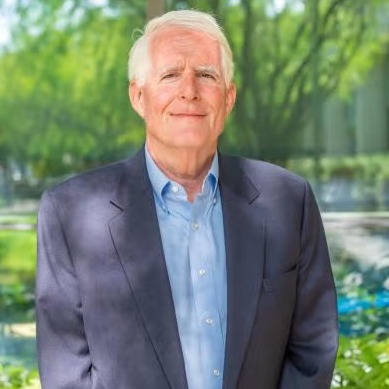
Gaylen Paulson
Associate Dean and Director, McCombs School of Business, The University of Texas at Austin
Senior Lecturer, Department of Management
25+ years of experience in executive education, negotiation strategy, and organizational communication
Know More
-
Eric Bickel
Professor and Director, Graduate Program in Operations Research & Industrial Engineering, The University of Texas at Austin
His research has been covered in WSJ, NYT, Sports Illustrated and more
His research is regarded as the top approach to address climate change
Know More
-
Jim Nelson
Lecturer, Management, The University of Texas at Austin
25 years of experience in wholesale banking, fintech, and health care
Co-founder and former chief technology officer of Simply Business
Know More
-
Clint Tuttle
Associate Professor of Instruction, The University of Texas at Austin
Award-winning expert in MIS, SQL programming, and data management.
Led IT capstone projects helping hundreds of industry clients.
Know More
-
Luis Martins
Professor, Management, Zlotnik Family Chair in Entrepreneurship, The University of Texas at Austin
His research has appeared in top management journals and newspapers
His research has also received several awards
Know More
-
Jeff Mihm
Lecturer, Department of Business, Government & Society, The University of Texas at Austin
Former CEO with nearly 30 years of experience in business and law.
Teaches courses in strategy, international business, and ethics.
Know More
-
Melissa Murphy
Associate Professor of Instruction, Management, The University of Texas at Austin
Expert in business communication, negotiation, and entrepreneurship.
Founder and chief communication coach of The Pitch Academy.
Know More
-
Dr. Prashant Joshi
Department of Information, Risk and Operations Management, UT Austin
Know More
-
John Daly
Professor, Management, The University of Texas at Austin
He has published 100+ articles and chapters in scholarly publications
He served as editor of two academic journals
Know More
-
Cam Houser
Founder, Actionworks; Lecturer, Innovation & AI, Texas Executive Education
AI pioneer who built a GPT-2 edtech product before ChatGPT existed.
Lecturer of Innovation & AI consulting for Apple, Dell, and more.
Know More
-
Ben Bentzin
Associate Professor of Instruction, Marketing, The University of Texas at Austin
McCombs Teaching Fellow focused on integrating AI into the classroom.
Former marketing chief for Dell's consumer & small business division.
Know More
-
Abhay Samant
Chief Software Engineer at NI, Professor of Practice, The University of Texas at Austin
Has 24 years of R&D, product strategy, business management experience
His research interests are in ML and cognitive cyberphysical systems
Know More


.jpg "Gaylen Paulson")






















 LinkedIn Profile
 University Link
Who Are the Mentors for Weekly Live Sessions?
Mentors may include*
-
G Anthony Reina
Head of Machine Learning, Exthymic Corporation
-
Jeremy Samuelson
Executive VP, AI and Innovation, Integrated Quantum Technologies
-
Sudhir Shandilya
Director, Digital Strategy, Transformation, and Operations Sanofi
-
Michael Lively
Founder, QuantumAI
-
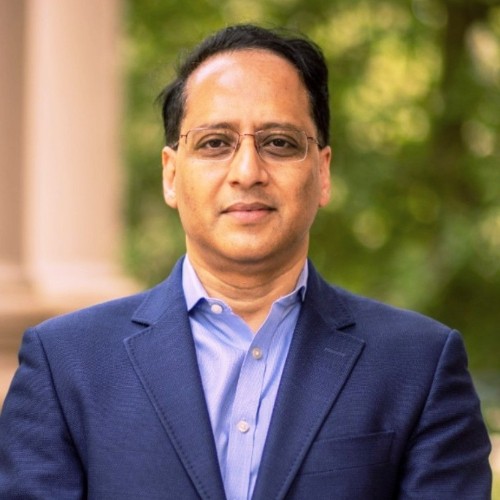
Arup Das
Senior Director Innovation - AI-Data Products-Analytics, Faegre Drinker










Note: The mentors listed above are indicative and subject to change based on availability and scheduling.
Earn Your Certificate Of Completion
Get the Chief AI Officer Program certificate from from the McCombs School of Business at The University of Texas at Austin upon successful completion of the program
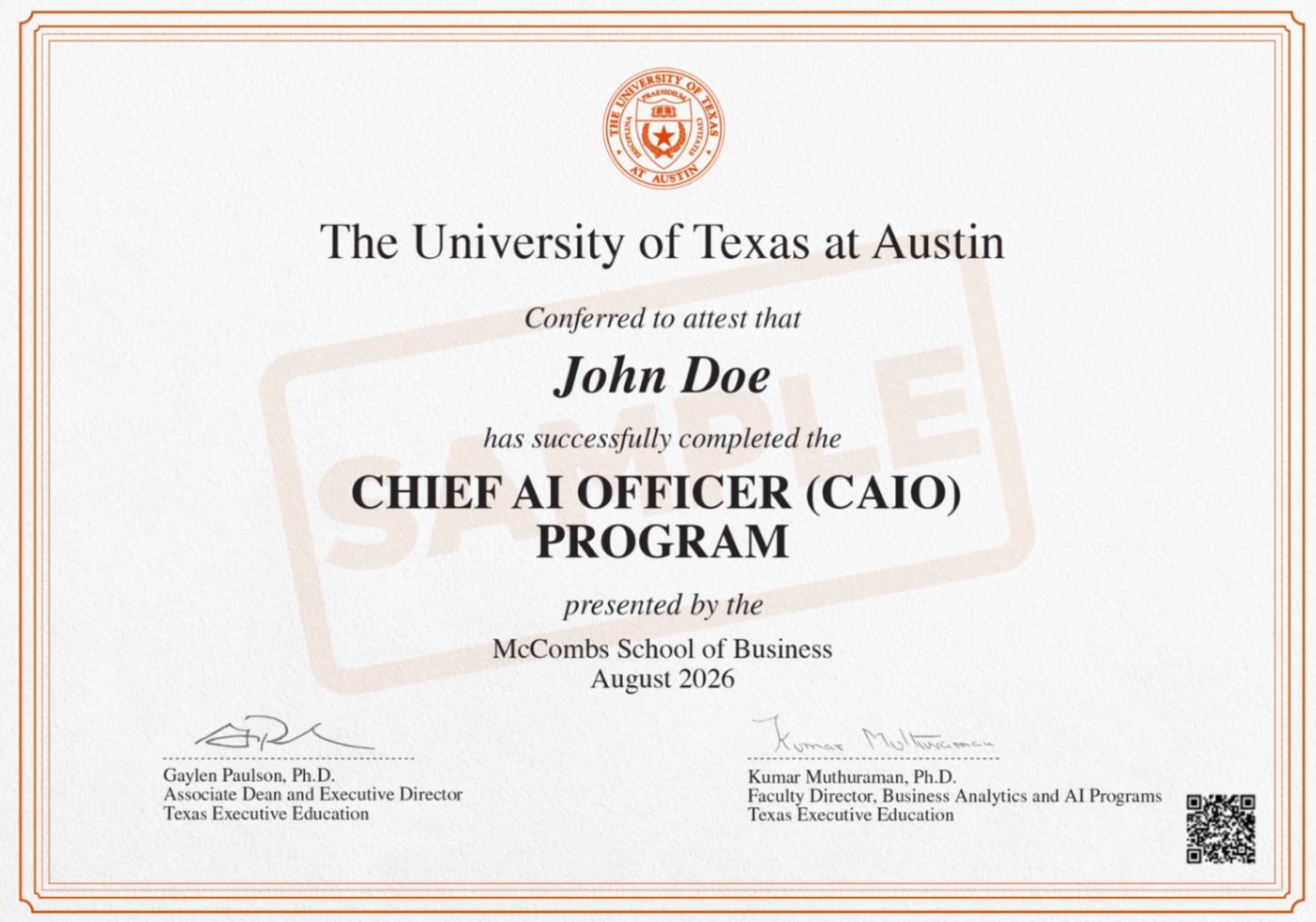
* Image for illustration only. Certificate subject to change.
Program Fee
The program fee is USD 19,000
Invest in your career
-
Identify the right business problems that will benefit from an AI solution, before investing resources
-
Understand how AI and ML work to evaluate technical claims, vendor pitches, and capability limits
-
Model AI ROI, including the hidden costs of governance, so your investment decisions hold up under scrutiny
-
Evaluate and approve technical decisions around models, data infrastructure, and agentic systems


Admission Process
The admission process is conducted on a rolling basis and will close once the requisite number of participants has been enrolled
-
APPLY
Fill out an online application form
-
REVIEW
A panel from Great Learning will review your application to evaluate your fit for the program
-
JOIN THE PROGRAM
Following a final review, you will receive an offer of admission to join the upcoming program cohort


Batch Start Date
-
Hybrid · January 2027
Admission closing soon
Delivered in Collaboration With:

The McCombs School of Business at The University of Texas at Austin is collaborating with Great Learning to deliver the Chief AI Officer Program. Great Learning is an ed-tech company that has empowered learners from over 170 countries to achieve positive career growth outcomes.
 Application closes
30th Oct 2026
Application closes
30th Oct 2026