phone iconSpeak with our expert +1 512 865 6389

Delivered in collaboration with Great Learning

Learn more about the course

Get details on syllabus, projects, tools, and more

Name
Email
Mobile Number

By submitting this form, you consent to our Terms of Use & Privacy Policy and to be contacted by us via Email/Call/Whatsapp/SMS.

Top-Rated Generative AI Course

Top-Rated Generative AI Course

Application closes 19th Mar 2026

overview icon

PROGRAM OUTCOMES

Leverage GenAI for Business Applications

Understand AI and Generative AI from business and technical perspectives

  • List icon

    Build a strong foundation in GenAI and develop the skills to create efficient, scalable AI solutions

  • List icon

    Analyze transformer architectures and LLMs for business use

  • List icon

    Learn to build and deploy AI agents for task automation and business impact

  • List icon

    Design AI workflows using RAG and agentic AI for data insights and efficiency

  • List icon

    Explore LangChain, LLMOps, and Agentic AI for real-world implementations

  • List icon

    Assess risks and implement mitigation strategies in Generative AI

Earn a Certificate of Completion from UT Austin

  • #1 (U.S., Big Data Management) in MS Business Analytic

    #1 (U.S., Big Data Management) in MS Business Analytic

    Eduniversal (2025)

  • #6 Analytics

    #6 Analytics

    U.S. News & World Report (2025)

  • #6 Business Programs

    #6 Business Programs

    U.S. News & World Report (2025)

  • #7 in MS - Business Analytics

    #7 in MS - Business Analytics

    QS World University Rankings (2022)

  • #7 in MS Business Analytics

    #7 in MS Business Analytics

    The Financial Engineer Times (2025)

  • #3 in Information Systems Graduate Programs

    #3 in Information Systems Graduate Programs

    U.S. News & World Report (April 2025)

  • #7 Public University in the U.S.

    #7 Public University in the U.S.

    U.S. News & World Report, 2026

  • #6 in Executive Education - Custom Programs

    #6 in Executive Education - Custom Programs

    Financial Times, 2022

KEY PROGRAM HIGHLIGHTS

Why Choose This Program

  • List icon

    Learn from a world-class university

    Learn from recorded lectures by world-renowned Texas McCombs faculty and mentorship from industry experts for a comprehensive experience.

  • List icon

    Industry-relevant curriculum

    Gain expertise in Generative AI tools and techniques like Prompt Engineering, Python, Prompt workflows, LLMOps, and more to solve business problems.

  • List icon

    Live mentored learning sessions

    Participate in 10 online mentor-led sessions where global industry experts present real-world case studies, offering practical insights into AI applications in business.

  • List icon

    Choose to learn with or without code

    Choose between a Python-based coding track or a no-code, tools-based track, and complete hands-on components using aligned technologies.

  • List icon

    Personalized assistance to accelerate learning

    Get personalized assistance from a dedicated program manager, and academic support through project discussion forums, and peer groups.

  • List icon

    Hands-on projects

    Work on 3 hands-on projects and 20+ case studies across, banking, financial services, insurance, healthcare, aviation, IT, and more.

  • List icon

    Create a compelling e-portfolio

    Develop an industry-ready portfolio that showcases your proficiency in the skills and tools you build throughout the program.

  • List icon

    Earn recognized credentials

    Upon program completion, earn a globally recognized certificate of completion from the McCombs School of Business at The University of Texas at Austin

Skills you will learn

Python

Generative AI

Prompt Workflows

GenAI for Data Analysis

NumPy

Pandas

GenAI for ML

AI Ethics

Problem solving with GenAI

Portfolio Building

Python

Generative AI

Prompt Workflows

GenAI for Data Analysis

NumPy

Pandas

GenAI for ML

AI Ethics

Problem solving with GenAI

Portfolio Building

view more

  • Overview
  • Learning Journey
  • Curriculum
  • Projects
  • Tools
  • Certificate
  • Faculty
  • Mentors
  • Reviews
  • Career Support
  • Fees
  • FAQ
optimal icon

This Program Is Ideal for

Professionals seeking a flexible learning track to learn how to leverage AI and lead initiatives.

  • Working Professionals

    Professionals looking to develop practical, industry-ready Generative AI skills.

  • Business & Tech Leaders

    Business and tech experts seeking a strong foundational understanding of Generative AI.

  • AI Enthusiasts

    Aspiring AI practitioners aiming to build technical expertise in Generative AI.

  • Decision-Makers & Innovators

    Decision-makers and innovators driving Generative AI adoption in the workplace.

Experience a Unique Learning Journey

Our pedagogy is designed to ensure career growth and transformation

  • banner-image

    Learn from world-renowned faculty

    Learn critical concepts through live masterclasses and recorded video lectures

  • banner-image

    Engage with your mentors

    Clarify your doubts and gain practical skills during weekly live sessions with industry experts

  • banner-image

    Work on hands-on projects

    Work on projects to apply the concepts and tools learnt in the module

  • banner-image

    Get personalized assistance

    Our dedicated program managers will support you through your learning journey

Comprehensive Curriculum

The curriculum, designed and delivered by Texas McCombs faculty, introduces learners to the foundational concepts of Generative AI and equips them with the skills needed to start or transition into a career in AI, with a strong focus on business applications.

PRE-WORK

This preparatory module introduces you to the world of data and AI, provides an overview of how industry problems are solved using these technologies, and builds a foundational understanding of the hands-on tools required to develop generative AI applications.

INTRODUCTION TO THE WORLD OF DATA AND AI

- Introduction to key terminology: Artificial Intelligence, Machine Learning, Deep Learning, Generative AI, Large Language Models - History and evolution of AI - Business problems and solution spaces across different industries

HANDS-ON TOOL INTRODUCTION AND SETUP

Code Tools: - Introduction to Python - Environment setup: Google Colab - Fundamental Python programming constructs: variables, data types, data structures (list, dictionary, tuple), conditional and looping statements, functions - OOP basics: classes, objects, inheritance No-Code Tools: - Introduction to no-code tools - Environment setup: GL N8N Labs - Core functionality and UI overview

MODULE 01 - GENERATIVE AI FOUNDATIONS

This module introduces the key domains and subdomains within the AI and Generative AI landscape. It explains how AI systems learn from data and identify patterns, and explores the core mechanisms behind neural networks and transformers. You will also learn how embedding techniques and semantic search can be applied to enhance natural language processing (NLP) tasks in business applications.

WEEK 1: GENERATIVE AI LANDSCAPE

Generative AI is a subset of AI that uses Machine Learning models to learn the underlying patterns and structures in large volumes of training data. It then uses that understanding to create new data, such as images, text, videos, and more. This module provides a comprehensive overview of Generative AI models, how they evolved, and how to apply them effectively to various business challenges. (History of Generative AI, Generative AI vs Discriminative AI, Interacting with Generative AI, Overview of Hallucination, Business Applications of Generative AI, Overview of Pandas, Pandas DataFrames, Visual Analysis of Data)

WEEK 2: AI FOUNDATIONS - MACHINE LEARNING

Machine Learning, a subset of Artificial Intelligence, focuses on developing algorithms that can learn patterns in data and make predictions. These algorithms do this without being explicitly programmed. This module introduces participants to the concept of learning from data. It covers what ML is, its types, and how to train and evaluate ML models for business applications. (The Notion of Learning from Data, Introduction to ML, Types of ML Problem and Solution Space for ML, Exploratory Data Analysis, Training ML Models, Evaluating ML models)

WEEK 3: AI FOUNDATIONS - DEEP LEARNING

Deep Learning is a branch of Machine Learning that uses Artificial Neural Networks (ANN), inspired by biological neurons. It utilizes a collection of artificial neurons stacked and connected in layers to model complex data. This module explores the underlying functionality of neural networks. It also covers how to use popular, open-source Deep Learning libraries, Keras and TensorFlow, to build neural networks that solve business problems. (Overview of Neural Networks, Neural Network Architecture, Activation Functions, Gradient Descent, Training a Neural Network, Backpropagation)

WEEK 4: EMBEDDINGS TO TRANSFORMERS

Embeddings allow us to represent complex textual data numerically. Transformers are neural network architectures that develop a context-aware understanding of data. They have revolutionized the field of AI. This module provides a comprehensive overview of embeddings and their role in capturing meaning from text data. It also covers the function of self-attention in the encoder component of transformers. Additionally, you will learn how to apply sentence transformers to enhance business applications. (The Need for Embeddings, Introduction to Transformers, Encoder Component of a Transformer, Attention and Self-Attention, Sentence Embeddings with Sentence Transformers, Semantic Search Applications)

WEEK 5: LEARNING BREAK

PROJECT WEEK: STOCK NEWS SENTIMENT ANALYSIS

Industry - Finance Summary - Analyze the data comprising stock news and prices and develop an AI-driven sentiment analysis system that will process and analyze news articles to gauge market sentiment to help financial analysts optimize investment strategies and improve client outcomes. Tools & Concepts - Google Colab, Hugging Face, Transformers, Sentence Transformers

MODULE 02 - BUSINESS APPLICATIONS WITH LLMs

This module helps you understand how transformers are used for text generation and how Large Language Models (LLMs) work. You will learn effective prompt engineering strategies to optimize LLM outputs for solving business problems. Additionally, you will explore how Retrieval-Augmented Generation (RAG) integrates information retrieval to improve the accuracy and relevance of responses generated by an LLM.

WEEK 7: TRANSFORMERS FOR TEXT GENERATION

Decoder-only transformers autoregressively generate text by predicting one word at a time based on previous words. This module will provide learners with a comprehensive view of the decoder component in transformers, including the role of masking, cross-attention, and autoregressive generation. It will also cover how decoder-only transformer models process and generate text, as well as how to apply transformers to real-world business use cases. (The Decoder Component of a Transformer, Masking, Cross Attention, Autoregressive Nature of the Decoder, Text Generation Applications)

WEEK 8: LARGE LANGUAGE MODELS AND PROMPT ENGINEERING

Large Language Models (LLMs) are ML models that are pre-trained on large corpora of data and possess the ability to generate coherent and contextually relevant content. Prompt engineering is a process of iteratively deriving a specific set of instructions to help an LLM accomplish a specific task. This module introduces LLMs, explains their working, and covers practices to devise prompts to solve problems using LLMs effectively. (Introduction to LLMs, Working of LLMs, Applications of LLMs, Introduction to Prompt Engineering, Strategies for Devising Prompts)

WEEK 9: RETRIEVAL AUGMENTED GENERATION

Retrieval Augmented Generation (RAG) combines the power of an encoder and generative models to produce more informative and accurate outputs from an external knowledge source. This module will provide a thorough coverage of the importance of external knowledge sources in enhancing an LLM’s accuracy and contextual awareness, using vector databases to store and efficiently retrieve information from data, and evaluating the quality and relevance of the LLM-generated text. (External Knowledge Sources, Data Chunking, Vector Databases, RAG, Evaluating RAG Systems)

PROJECT WEEK: MEDICAL ASSISTANT

Industry - Healthcare Summary - Utilize sentence embeddings, vector databases, and Retrieval-Augmented Generation (RAG) to enhance information retrieval for a medical chatbot and provide accurate and context-aware responses, ensuring reliable and relevant medical guidance. Tools & Concepts - Generative AI, Large Language Models, Prompt Engineering, Hugging Face, Retrieval Augmented Generation, Vector Databases.

MODULE 03 - RESPONSIBLE GENERATIVE AI SOLUTIONS

This module will help you build agentic AI workflows to automate and enhance decision-making processes, gain insights into the purpose and process of fine-tuning pre-trained models to improve performance on specific business tasks, and identify and mitigate biases and risks in generative AI solutions.

WEEK 11: FINE-TUNING LLMs

Fine-tuning LLMs involves training a pre-trained Large Language Model on domain-specific data to adapt it for specialized tasks, thereby improving its performance while retaining general language understanding. This module provides a comprehensive overview of the need for fine-tuning in adapting Large Language Models to specific business use cases, analyzing Parameter-Efficient Fine-Tuning (PEFT) techniques for optimizing model performance, and implementing QLoRA-based fine-tuning strategies to enhance LLM efficiency while minimizing computational costs. (The Need for Fine-Tuning, Parameter-Efficient Fine-Tuning (PEFT), PEFT Techniques (Prefix Tuning, Prompt Tuning, QLoRA), QLoRA Application and Implementation)

WEEK 12: AGENTIC AI WORKFLOWS

Agentic AI workflows involve methodologies for designing, automating, and managing the decision-making processes using AI agents to achieve specific goals. This module provides a comprehensive overview of LangChain, a versatile framework for integrating LLMs with external tools and services. It covers various types of AI agents, exploring the architecture and design principles for building them within LangChain. (Introduction to AI Agents, Agentic AI Tools, AI Agents within LangChain, Agentic AI Workflows, Types of AI Agents)

WEEK 13: RESPONSIBLE AI AND LLM SECURITY

Responsible AI involves creating AI systems that produce accurate outputs in an ethical, transparent, and fair manner. The goal is to ensure these systems benefit society while minimizing potential harm. This module covers key aspects of AI ethics. It provides an overview of identifying and mitigating bias and risk in AI systems. The module also highlights the importance of ethical considerations in AI development and reviews the laws and regulations governing secure AI use. (Identifying Bias and Risk in Human and AI Systems, Mitigating Bias and Risk in AI, Laws and Regulations for Responsible AI Use)

PROJECT WEEK: FOODHUB CHATBOT

Industry: Retail Summary: Build an AI-powered chatbot for an online food delivery organization that automates order-related customer support, delivers accurate and safe real-time responses, reduces operational costs, and enhances overall customer satisfaction through intelligent escalation and guardrails. Tools and Concepts: Large Language Models, Prompt Engineering, AI Agents, ReAct, Responsible AI

SELF-PACED MODULES

This module will help you explore how to solve business problems by generating code using Generative AI tools, examine the capabilities of text-to-image and image-to-text GenAI tools like DallE through business use cases, and explore the speech recognition capabilities of audio-to-text GenAI tools like Whisper through business use cases. - Image Captioning using GenAI - Speech Recognition using GenAI

MULTIMODAL GENERATIVE AI

This course will help you explore how to solve business problems by generating code using Generative AI tools, examine the capabilities of text-to-image and image-to-text GenAI tools like DallE through business use cases, and explore the speech recognition capabilities of audio-to-text GenAI tools like Whisper through business use cases. - Image Captioning using GenAI - Speech Recognition using GenAI

INTRODUCTION TO LLMOps

This course will provide you with an overview of the basic principles of MLOps and LLMOps. You will also explore how to deploy Generative AI solutions effectively using web applications. The course also ensures that the solutions are scalable to wider audiences, helping to solve business problems. - Overview of MLOps and LLMOps Deploying - Generative AI Solutions using Web Apps

Leverage GenAI for Business Applications

Build industry-relevant skills with projects guided by experts.

  • Hands-On

    Projects

  • 20+

    Case Studies

  • Code or No-Code

    Flexible Learning Tracks

project icon

FINANCE

Stock News Sentiment Analysis

Description

Analyze data comprising stock news and prices and develop an AI-driven sentiment analysis system that will process and analyze news articles to gauge market sentiment to help financial analysts optimize investment strategies and improve client outcomes.

Skills you will learn

  • Google Colab
  • Hugging Face
  • Transformers
  • Sentence Transformers
project icon

HEALTHCARE

Medical Assistant

Description

Utilize sentence embeddings, vector databases, and Retrieval-Augmented Generation (RAG) to enhance information retrieval for a medical chatbot and provide accurate and context-aware responses, ensuring reliable and relevant medical guidance.

Skills you will learn

  • "Generative AI
  • Large Language Models
  • Prompt Engineering
  • Hugging Face
  • RAG
  • Vector Databases
project icon

RETAIL

Foodhub Chatbot

Description

Build an AI-powered chatbot for an online food delivery organization that automates order-related customer support, delivers accurate and safe real-time responses, reduces operational costs, and enhances overall customer satisfaction through intelligent escalation and guardrails.

Skills you will learn

  • Large Language Models
  • Prompt Engineering
  • AI Agents
  • ReAct
  • Responsible AI

Master Cutting-Edge Generative AI Tools

GenAI training with 15+ tools to build, enhance, and deploy scalable models

  • tools-icon

    Python

  • tools-icon

    Pandas

  • tools-icon

    Matplotlib

  • tools-icon

    Seaborn

  • tools-icon

    Scikit-Learn

  • tools-icon

    TensorFlow

  • tools-icon

    Keras

  • tools-icon

    Hugging Face

  • tools-icon

    LangChain

  • tools-icon

    FAISS

  • tools-icon

    ChatGPT

  • tools-icon

    Gemini

  • tools-icon

    Dall.E

  • tools-icon

    Whisper

  • tools-icon

    Streamlit

  • tools-icon

    KNIME

  • tools-icon

    n8n

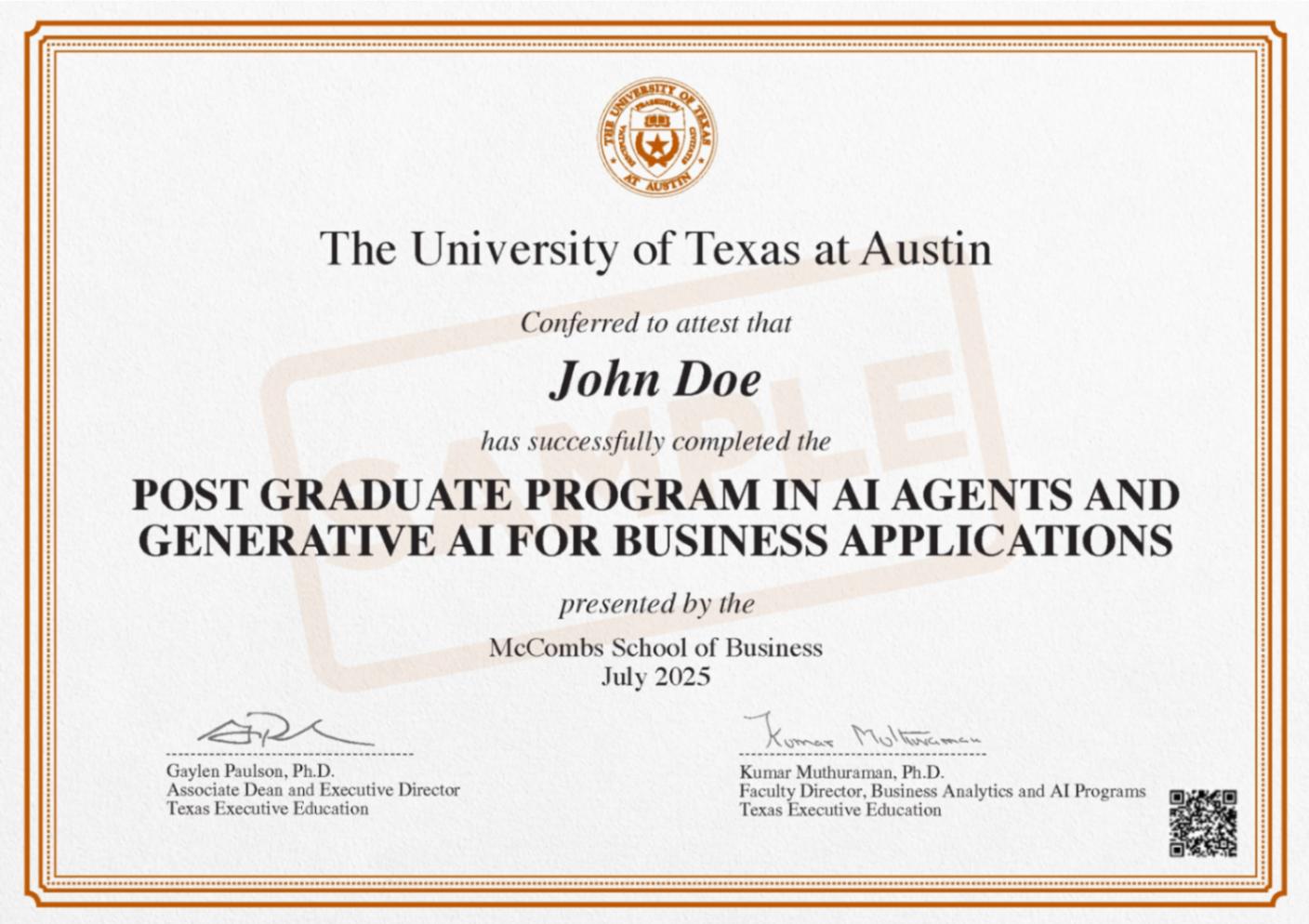
Earn a Certificate of Completion and 4.0 Continuing Education Units (CEUs)

Get a Post Graduate certificate from a top-tier university and boost your career prospects.

certificate image

* Image for illustration only. Certificate subject to change.

Meet Your faculty

Learn from the top, world-renowned faculty at UT Austin

  • Dr. Kumar Muthuraman - Faculty Director

    Dr. Kumar Muthuraman

    Faculty Director, McCombs School of Business, The University of Texas at Austin

    Faculty Director, Center for Analytics and Transformative Technologies

    21+ years' experience in AI, ML, Deep Learning, and NLP.

    Know More
    Company Logo
  • Dr. Abhinanda  Sarkar - Faculty Director

    Dr. Abhinanda Sarkar

    Senior Faculty & Director Academics, Great Learning

    30+ years of experience in data science, ML, and analytics.

    Ph.D. from Stanford, taught at MIT, ISI, and IIM Bangalore.

    Know More
    Company Logo
  • Dr. Daniel A Mitchell  - Faculty Director

    Dr. Daniel A Mitchell

    Clinical Assistant Professor, McCombs School of Business, The University of Texas at Austin

    Research Director, Center for Analytics and Transformative Technologies

    15+ years of experience in financial engineering and quantitative finance.

    Know More
  • Dr. Pavankumar Gurazada - Faculty Director

    Dr. Pavankumar Gurazada

    Senior Faculty, Academics, Great Learning

    15+ years of experience in marketing, digital marketing, and machine learning.

    Ph.D. from IIM Lucknow; MBA from IIM Bangalore; IIT Bombay graduate.

    Know More
    Company Logo

Interact with Our Mentors

Interact with dedicated AI and Machine Learning experts who will guide you in your earning and career journey

  •  Bhaskarjit Sarmah  - Mentor

    Bhaskarjit Sarmah linkin icon

    Head of AI Research, Domyn
    Company Logo
  •  Omid Badretale - Mentor

    Omid Badretale linkin icon

    Senior Research Data Scientist | Alternative Data RBC Capital Markets
    RBC Capital Markets Logo
  •  Davood Wadi  - Mentor

    Davood Wadi linkin icon

    AI Research Scientist intelChain
    intelChain Logo
  •  Vinicio Desola Jr  - Mentor

    Vinicio Desola Jr

    Senior AI Engineer Newmark
    Newmark Logo
  •  Joel Kowalewski  - Mentor

    Joel Kowalewski linkin icon

    Chief AI Scientist Stealth Mode Biotech
    Stealth Mode Biotech Logo

Get Dedicated Career Support

  • banner-image

    Resume & profile review

    Polish your resume to better showcase your skills and experience.

  • banner-image

    Career preparation material

    Explore how to apply skills and competencies for professional advancement, with strategies to accelerate career growth.

  • banner-image

    E-portfolio

    Build an industry-ready portfolio to showcase your mastery of skills and tools

  • banner-image

    Earn globally recognized credentials

    Upon program completion, earn a Professional Certificate of Completion from Texas McCombs to showcase to your network.

Course Fees

The course fee is USD 2,950

Invest in your career

  • benifits-icon

    Choose from two flexible tracks: a Python coding track or a no-code tools track with hands-on components

  • benifits-icon

    Learn to build and deploy AI agents, and design AI workflows using RAG and for data insights and efficiency

  • benifits-icon

    Analyze transformer architectures and LLMs for business use

  • benifits-icon

    Build a strong foundation in GenAI and develop the skills to create efficient, scalable AI solutions

Take the next step

timer
00 : 00 : 00

Apply to the program now or schedule a call with a program advisor

Unlock exclusive course sneak peek

Application Closes: 19th Mar 2026

Application Closes: 19th Mar 2026

Talk to our advisor for offers & course details

Admission Process

Admissions close once the required number of participants enroll. Apply early to secure your spot

  • steps icon

    1. Fill application form

    Apply by filling a simple online application form.

  • steps icon

    2. Interview Process

    A panel from Great Learning will review your application to determine your fit for the program.

  • steps icon

    3. Join program

    After a final review, you will receive an offer for a seat in the upcoming cohort of the program.

Course Eligibility

  • Applicants should have a Bachelor's degree with a minimum of 50% aggregate marks or equivalent

Batch start date

  • Online · 18th Apr 2026

    Admission closing soon

Delivered in Collaboration with:

The McCombs School of Business at the University of Texas at Austin is is collaborating with online education provider Great Learning to offer the Post Graduate Program in Generative AI for Business Applications. Great Learning collaborates with institutions to manage enrollments (including all payment services and invoicing), technology, and participant support.

Got more questions? Talk to us

Connect with our advisors and get your queries resolved

Speak with our expert +1 512 865 6389 or email to genai.utaustin@mygreatlearning.com

career guidance

Frequently asked questions

Program Details
Eligibility Criteria
Fee Related Queries
Admission Queries
General Queries
Program Details

What is the Post Graduate Program in Generative AI for Business Applications from the McCombs School of Business at The University of Texas at Austin?

The Post Graduate Program in Generative AI for Business Applications by the McCombs School of Business at The University of Texas at Austin is a 14-week program designed for professionals looking to build a strong foundation in Generative AI and leverage its power to solve real-world business challenges. Through the program, learners will familiarize themselves with the tools and techniques required to solve business problems using AI and Generative AI.

Why choose this Post Graduate Program in Generative AI for Business Applications?

Here’s why you should choose the Post Graduate Program in Generative AI for Business Applications: 


  • Designed for professionals: Specifically created for individuals who want to build a strong foundation in Generative AI and apply it to real-world business problems. 
  • Certificate by a prestigious institution: Earn a certificate from The University of Texas at Austin. 
  • Hands-on experience: Learn by doing through real-world projects, case studies, and practical assignments. 
  • Comprehensive skill-building: Master Machine Learning, Deep Learning, and Generative AI to analyze data, build AI workflows, and deliver actionable insights. 
  • Industry-ready training: Develop a strong portfolio demonstrating your ability to implement AI solutions across business functions. 
  • Advanced topics: Includes key areas like automation, ethical AI usage, and security considerations. 
  • Faculty and Expert mentorship: Learn from top academic and industry leaders with real-world experience. 
  • Career advancement: Ideal for entering or accelerating a career in the fast-growing field of Generative AI.

What are the learning outcomes of this program?

The learning outcomes of the Post Graduate Program in Generative AI for Business Applications are: 


  • Gain a good understanding of the AI and Generative AI landscape from a business and technical perspective. 
  • Gain a strong foundation in Generative AI and master the top tools and technologies driving innovation. 
  • Master the skills needed to develop efficient and scalable solutions leveraging Generative AI models. 
  • Utilize transformers and Large Language Models (LLMs) to design and implement effective solutions for business applications. 
  • Design AI workflows using retrieval augmented generation and agentic AI to extract meaningful insights from unstructured data and enhance business process efficiency. 
  • Evaluate risks and implement mitigation strategies to build secure Generative AI applications.

What concepts and tools are covered in the course?

Students will get familiar with several in-demand concepts and 15+ GenAI tools in this course, including: 


  • Python 
  • Pandas 
  • NumPy 
  • Seaborn 
  • Matplotlib 
  • Scikit-Learn 
  • Hugging Face 
  • Transformers 
  • LangChain 
  • FAISS 
  • ChatGPT 
  • Gemini 
  • Dall.E 
  • Whisper 
  • Streamlit, and more

What is the ranking of the McCombs School of Business at the University of Texas at Austin?

Business Analytics ranks Texas McCombs as the 6th best institution worldwide based on the QS World University Rankings 2021. The U.S. News & World Report has consistently ranked Texas McCombs among the top 20 public universities, as it offers 40+ postgraduate and 15 undergraduate programs listed in the top 10 nationwide.


Will I be awarded any certificate after completing the course?

Upon successfully finishing the course, you will receive a completion certificate in Data Analytics Essentials from The University of Texas at Austin.

Will I still have access to the learning materials after completing the course?

After the program finishes, you will have access to all learning materials through the online platform for one year, including lecture notes, online content, and supporting resources.

What topics will be covered in the curriculum for the Generative AI for Business Application program?

The Generative AI for Business Applications curriculum is designed and taught by the faculty at the McCombs School of Business at the University of Texas at Austin, along with top industry practitioners. 


The program's objective is to familiarize learners with the foundational concepts of Generative AI, equipping them with the skills needed to establish or transition into a career in AI and Generative AI. With a strong focus on business applications, the program explores how Generative AI can drive innovation across industries.

Who is this program for?

The Generative AI for Business program by the McCombs School of Business at The University of Texas at Austin is designed for: 


  • Professionals looking to develop practical, industry-ready Generative AI skills 
  • Business and tech experts seeking a strong foundational understanding of Generative AI 
  • Aspiring AI practitioners aiming to build technical expertise in Generative AI 
  • Decision-makers and innovators driving Generative AI adoption in the workplace

Who would be the faculty to teach the Post Graduate Program in Generative AI for Business Applications?

The renowned faculty members of The McCombs School, along with highly skilled business analysts from around the globe, will teach this program. A few of the notable program faculty and industry experts include:


Dr. Kumar Muthuraman


Faculty Director, Center for Analytics and Transformative Technologies, McCombs School of Business, the University of Texas at Austin


Dr. Daniel A Mitchell


Clinical Assistant Professor, Department of Information, Risk & Operations Management, McCombs School of Business, The University of Texas at Austin


Dr. Abhinanda Sarkar

Senior Faculty & Director Academics, Great Learning


Dr. Pavankumar Gurazada


Senior Faculty, Academics, Great Learning


The mentorship sessions will be with industry experts working in world-renowned companies like IntelChain, BlackRock, Newmark, RB Capital Market, and more.

Eligibility Criteria

Who can enroll in this Post Graduate Program in Generative AI for Business Applications?

The program is designed for business and tech experts, professionals, and aspiring AI practitioners who want to advance their careers. Applicants should have a Bachelor's degree with a minimum of 50% aggregate marks or equivalent.

Fee Related Queries

What is the Generative AI for Business Applications program fee?

For fee-related queries, please contact program advisors and visit the official website.

Admission Queries

What is the admission process to pursue this Generative AI for Business Application program?

The applicants need to fulfill the eligibility criteria, which were introduced earlier, before enrolling in this course. The steps to admit eligible candidates follow this procedure: 


Step 1: Fill application form Apply by filling out a simple online application form.

Step 2: Interview Process A panel from Great Learning will review your application to determine your fit for the program. 

Step 3: Join the program After a final review, you will receive an offer for a seat in the program's upcoming cohort. 


Note: Document verification is required before admission to the program.

What is the deadline for enrolling in this program?

Admissions cease once the required number of participants has registered for the upcoming batch. The few seats available for this course are subject to the first-come, first-served rule. Apply before time to secure your seats.

General Queries

How can Generative AI improve operational efficiency in business?

Generative AI helps businesses streamline operations by automating repetitive tasks, enhancing data analysis, and improving customer service through AI-driven chatbots and assistants. It reduces manual workloads and improves decision accuracy in areas like supply chain management and fraud detection.

What is the importance of Generative AI for business leaders?

Generative AI has become a strategic imperative for businesses, reshaping industries by improving decision-making and optimizing operations. Leading enterprises, like Morgan Stanley and Visa, have integrated Generative AI to enhance wealth management, fraud detection, and risk management. As AI adoption accelerates, business leaders must ensure they have the skills to leverage its potential, as 62% of professionals feel unprepared to use AI effectively. Closing this skills gap is crucial for leaders who wish to drive innovation and gain a competitive advantage in an increasingly AI-driven world.

What are the key Gen AI business applications transforming industries?

The key Generative AI applications transforming industries are: 


  • AI-powered investment insights: Top industries leverage AI-driven tools to analyze large datasets, providing real-time insights that help wealth managers optimize investment strategies. 

  • Fraud detection systems: AI models enhance fraud detection and risk management, improving security and reducing financial losses. 

  • AI-driven chatbots: Generative AI chatbots automate customer queries and support, enhancing user experience by providing quick, relevant responses. 

  • AI-based document analysis: Generative AI is used to automate the summarization and analysis of legal documents, saving time and reducing errors. 

  • Real-time inventory and logistics tracking: AI integrates external knowledge sources and uses Retrieval-Augmented Generation (RAG) to optimize supply chain management by providing accurate, timely updates. 

  • Medical assistants: Generative AI tools enable healthcare professionals to retrieve and analyze patient data efficiently, providing context-aware medical guidance through AI-powered assistants.

What will I learn in the Generative AI for Business course?

In the Generative AI for Business course, you will: 


  • Understand the fundamentals of AI and Generative AI, including machine learning, deep learning, and transformer models. 
  • Learn how to design and implement AI-driven solutions for business problems, leveraging tools like Large Language Models (LLMs), transformers, and sentence embeddings. 
  • Master techniques to automate decision-making processes and develop scalable AI workflows for diverse business applications. 
  • Gain hands-on experience through industry-focused projects, such as sentiment analysis in finance, AI-powered medical assistants, and legal document summarization tools. 
  • Learn ethical considerations in AI, including identifying biases and ensuring security, transparency, and responsible AI deployment. 
  • Develop practical, industry-ready skills to implement Generative AI solutions, driving innovation and improving business efficiency across functions.

What skills do I need to implement Generative AI in my business?

You need a strong foundation in AI, machine learning, data analysis, and the specific tools used in Generative AI, such as large language models (LLMs) and transformers. Learning how to work with AI models, program with Python, and integrate AI into business processes is essential.